



Table of Contents
Ready to See Results?
From strategy through execution, Atlantic Health Strategies integrates compliance, operations, and growth into durable, measurable results. Let’s put our expertise to work for your organization.
Eight operators, three sub-segments, one shared 2027 window
Eight behavioral health platforms, spread across SUD residential, outpatient mental health, IOP/PHP rollups, and psychiatric service lines, are tracking toward 2027 sale processes based on fund vintage math, growth plateau, and roll-up maturity. Operators eyeing a similar window should benchmark three variables that materially move EBITDA multiples in a buyer-favorable market: payer mix durability, Joint Commission or CARF accreditation posture, and multi-state licensure depth.
The macro backdrop is not generous. Mertz Taggart counted 180 behavioral health transactions in 2025, up only slightly from 176 in 2024, and Q2 2026 was the lightest closed-M&A quarter in their data set going back to 2022. Kevin Taggart has described a trend of fewer deal announcements as private equity faces 12 to 24 months of public and regulatory scrutiny. That is the market the 2027 sellers will walk into.
Who is in the eight? Think of it as a composite: two SUD residential operators with 2020-2021 sponsors approaching end of hold, two outpatient MH platforms with scaled psychiatry footprints, two IOP/PHP rollups built through add-on volume, and two psychiatric service-line carve-outs from health systems. These are not names on a leaked list. They are the archetypes buyers are modeling right now, and if your platform looks like one of them, your 2027 process is already being pre-priced.
What buyers are actually paying: the 2025-2026 multiple ranges
The headline numbers have compressed, but not uniformly. FOCUS puts mid-market behavioral health platforms with $3M to $20M EBITDA in the 7x to 12x range depending on scale, payer mix, and service acuity. Large multi-state platforms clear roughly 9x to 13x, while smaller regional or single-state operators sit at 3x to 8x. Add-on deals in roll-up strategies continue to trade in the 4x to 8x range, with platform deals at 8x to 14x.
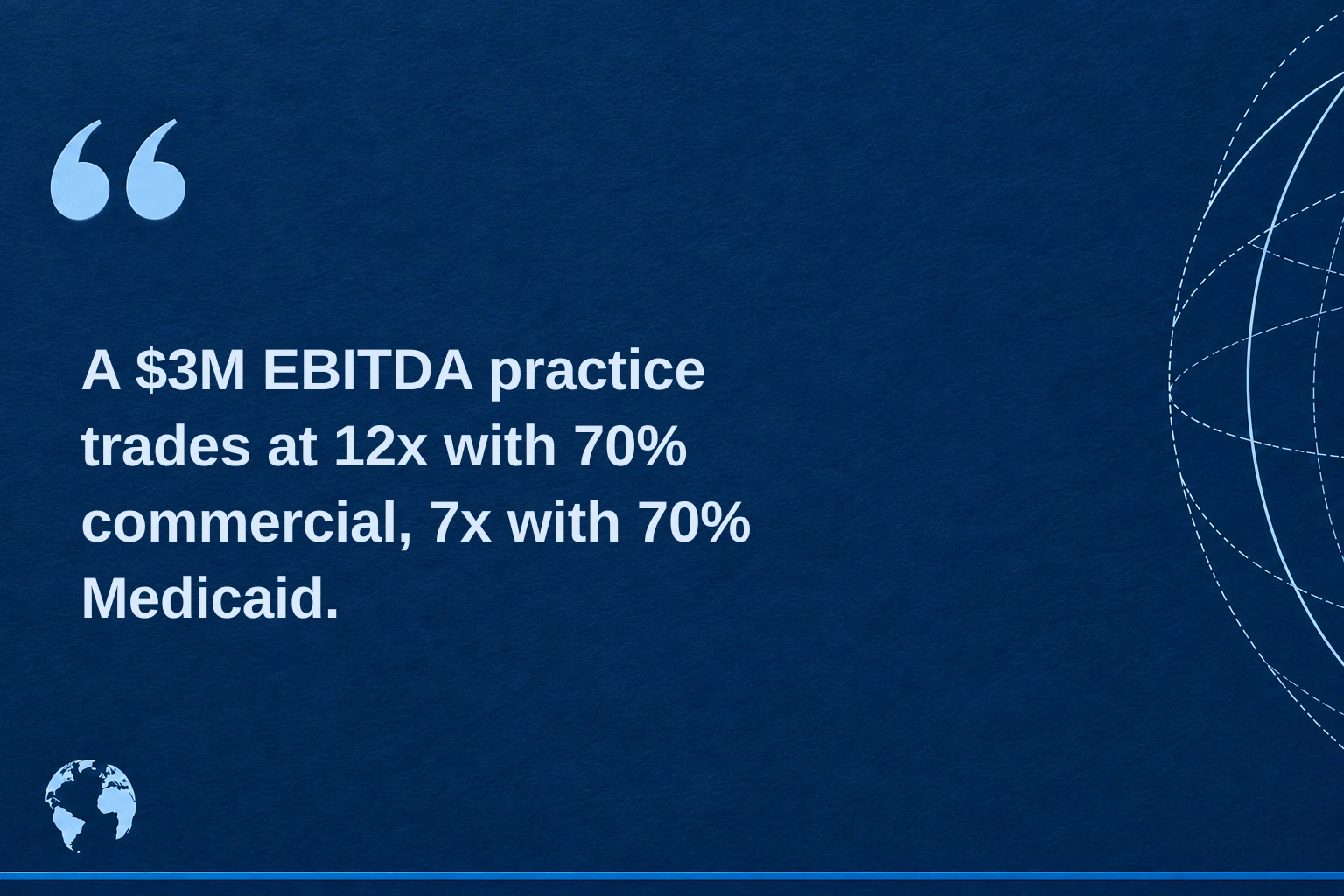
Payer mix is the single biggest swing factor. One advisory group put the dynamic plainly: “A $3M EBITDA behavioral health practice with 70% commercial insurance trades at 12x+. The same EBITDA with 70% Medicaid trades at 7x.” That is a $15 million enterprise value delta on the same cash flow. Operators who assume a durable commercial book without the payer contracts to prove it are in for a diligence surprise.
Sub-segment matters too. Scope Research pegs single SUD facilities and small portfolios under $10M revenue at 3x to 8x EBITDA, while scaling addiction treatment platforms with strong continuing management can reach 10x to 15x. Mertz Taggart flagged that addiction treatment saw its lowest total deal volume in six years in 2025, which is both a warning and an opportunity for the handful of SUD operators who can present a clean 2027 story.
Fund vintage math is pushing the 2027 wave
Most of the names you will hear whispered about 2027 are backed by 2020 or 2021 vintage funds. Standard hold is five to seven years. That math alone forces a decision window between late 2026 and 2028, which is why bankers are already pitching for Q1 and Q2 2027 launch dates.
Private equity has committed over $5 billion to behavioral health assets since 2020, and deal volume has not slowed despite higher interest rates. That capital needs an exit path. Mertz Taggart’s Q1 2026 report tracked $535.7 million in disclosed growth-deal value, led by Talkiatry and Grow Therapy, which signals continued institutional conviction in scaled virtual platforms. Sponsors with assets that fit that profile will push into the window; sponsors with assets that do not will consider continuation vehicles, minority recaps, or structured secondaries.
The quiet subtext: per Taggart, some 2025 PE-backed acquirers specifically did not want deals announced in order to avoid drawing additional attention. If you are a founder watching the trades for signals, you are seeing a filtered version of what is actually trading. Build your 2027 thesis on diligence posture, not press releases.
The 18 to 24 month operational runway that moves your multiple
Investment banks will not fix your chart audits. Data trackers will not rebuild your payer mix. The work that moves a 2027 multiple is operator-side and starts now. Here is the runway I would hand a CEO targeting a Q2 2027 close:
- Accreditation posture. If you are sitting on a one-year provisional CARF or a conditional Joint Commission status, buyers will discount. Mock survey, EOC tour, and finding remediation take 9 to 12 months to execute credibly.
- Payer mix rebalancing. Rebalancing a Medicaid-heavy book toward commercial through targeted MHPAEA-aware contracting takes a full managed care cycle. Statutory parity requirements under the 2008 law and the CAA 2021 comparative analysis obligations remain enforceable even though the Departments of Labor, HHS, and Treasury announced on May 15, 2025 that they would not enforce the 2024 MHPAEA final rule. Commercial-heavy platforms still carry parity-related reimbursement exposure buyers will test.
- Multi-state licensure depth. If your Texas license is pending with HHSC and your Montana license is in renewal with the state board, a buyer will discount for execution risk. Clean, current licensure across at least three states is the floor for a platform premium.
- Quality of earnings prep. Deal timelines lengthened in 2025 as lenders conducted forensic diligence on insurance receivables and cash collections, an effect lingering from the Change Healthcare disruption and ongoing Medicaid uncertainty. Clean 36-month revenue recognition, aged AR reserves that match collection reality, and a chart audit sample buyers can reproduce.
- Regulatory file. HHS OIG enforcement priorities, DEA registration posture for any OTP or buprenorphine assets following the X-waiver elimination under the Consolidated Appropriations Act 2023, 42 CFR Part 2 alignment with HIPAA, and SAMHSA notifications all need to be clean. A single unresolved SIU audit is a price adjustment.
- State transaction notice regimes. A Mertz Taggart tally found at least 14 states now require advance notice to the attorney general or related agency before a PE, hedge fund, or MSO-affiliated healthcare transaction closes. That changes your signing-to-closing timeline. Build it into the exit calendar now.
Operators who start this work in 2026 trade at the top of their range. Operators who start it in Q1 2027 trade at a discount or do not clear.

Frequently asked questions
What EBITDA multiple range should a mid-size SUD operator expect in a 2027 exit?
A single-site or small-portfolio SUD operator under $10M revenue should model 3x to 8x EBITDA. A scaled SUD platform with multi-state footprint, in-network commercial contracts, continuing management, and demonstrated growth can push into the 10x to 15x range. The gap is almost entirely explained by scale, payer mix, and accreditation posture, not by clinical model.
How do accreditation status and state licensure footprint affect buyer interest?
A clean three-year Joint Commission or CARF status plus licensure in three or more states is the floor for a platform premium. Provisional accreditation or a single-state footprint caps most assets at add-on pricing in the 4x to 8x range, regardless of EBITDA quality. Buyers price the remediation cost and the execution risk, and both are expensive.
Which PE fund vintages are driving the 2027 BH exit wave?
Primarily 2020 and 2021 vintages hitting the five-to-seven-year hold mark. Some 2019 funds that extended through COVID will also push into the window. Sponsors with strong assets will run processes; sponsors with underperforming assets will explore continuation vehicles or structured secondaries rather than accept a down-round exit.
How does the 2024 MHPAEA final rule change diligence risk for commercial-heavy platforms?
The 2024 final rule is in enforcement limbo after the May 15, 2025 non-enforcement announcement, but the underlying 2008 statute and the CAA 2021 comparative analysis requirements remain fully enforceable. Buyers of commercial-heavy platforms will still diligence NQTL exposure, denial rates, and prior-authorization patterns, because state regulators and private plaintiffs are not bound by the federal non-enforcement posture.
What quality-of-earnings red flags are most common in BH diligence today?
Insurance AR that is not reserved against actual collection history, revenue recognized before authorization is confirmed, census concentration in one or two referral sources, unresolved SIU audits, and chart documentation that cannot support the level of care billed under ASAM Criteria 4th Edition. Lenders are running forensic-level diligence on insurance receivables and cash collections, so a sloppy revenue cycle costs real multiple.
References
- Mertz Taggart, Q4 2025 Behavioral Health M&A Report
- Mertz Taggart, Q1 2026 Behavioral Health M&A Report
- Mertz Taggart, Q2 2026 Behavioral Health M&A Report
- Behavioral Health Business, Behavioral Health Dealmaking Dips to Pre-Pandemic Levels
- FOCUS Investment Banking, Healthcare EBITDA Multiples 2026 Dashboard
- FOCUS Investment Banking, Valuation Multiples by Industry: Healthcare Services 2026
- Sofer Advisors, Behavioral Health Roll-Ups: Platform and Add-On Pricing
- Scope Research, SUD Treatment Valuation Multiples and M&A Trends 2025
- Praxis Rock, Average EBITDA Multiples by Industry 2026
- American Hospital Association, Agencies Will Not Enforce 2024 MHPAEA Final Rule
- Axia Growth Advisors, Behavioral Health M&A Buyers and Deal Trends 2026
- HMP Global, Q4 2025 Behavioral Health M&A Report Summary