



Table of Contents
Ready to See Results?
From strategy through execution, Atlantic Health Strategies integrates compliance, operations, and growth into durable, measurable results. Let’s put our expertise to work for your organization.
The 3% cut, the second 3%, and what it actually hits
Nebraska DHHS announced a 3% Medicaid reimbursement rate cut in fiscal year 2027 and a second 3% cut the following fiscal year, and behavioral health facility operators with Nebraska census should model the compounded 6% hit against their Medicaid payer mix now, before the Appropriations Committee closes markup. Nebraska Public Media reported the announcement came in a Friday-night email from Tony Green, DHHS Division of Disability and Aging director, to providers. The Developmental Disabilities Waiver population takes a steeper 4% cut in 2027 and again in 2028, which matters for operators running co-occurring IDD and SUD programming.
What the numbers look like in practice. Nebraska Medicaid’s SFY27 Mental Health and Substance Use fee schedule (effective July 1, 2026) already pays $283.19 per day for psychiatric residential treatment, which is the lowest on the 50-state chart. A 6% compounded reduction pulls that number toward $266 before any Heritage Health MCO withhold or quality adjustment. Minnesota pays $1,244.07 a day and Ohio $1,092.60 for the same bundled residential service, which should frame how little headroom Nebraska facilities have left.
The Pillen administration also moved on a $152 million DHHS cut package earlier in the year, which drew testimony from the Nebraska Hospital Association, Nebraska Medical Association, Children’s Nebraska, and the Nebraska Health Care Association. Drew Gonshorowski, director of the Division of Medicaid and Long-Term Care (MLTC), testified that the proposed cuts would still permit, in his words, sustainable coverage
. Operators should read that statement as the state’s working definition of acceptable rate adequacy, because MLTC will use it to defend the SPA filings that implement whatever the Unicameral passes.
Heritage Health MCOs, DSH, and how the cut actually reaches your P&L
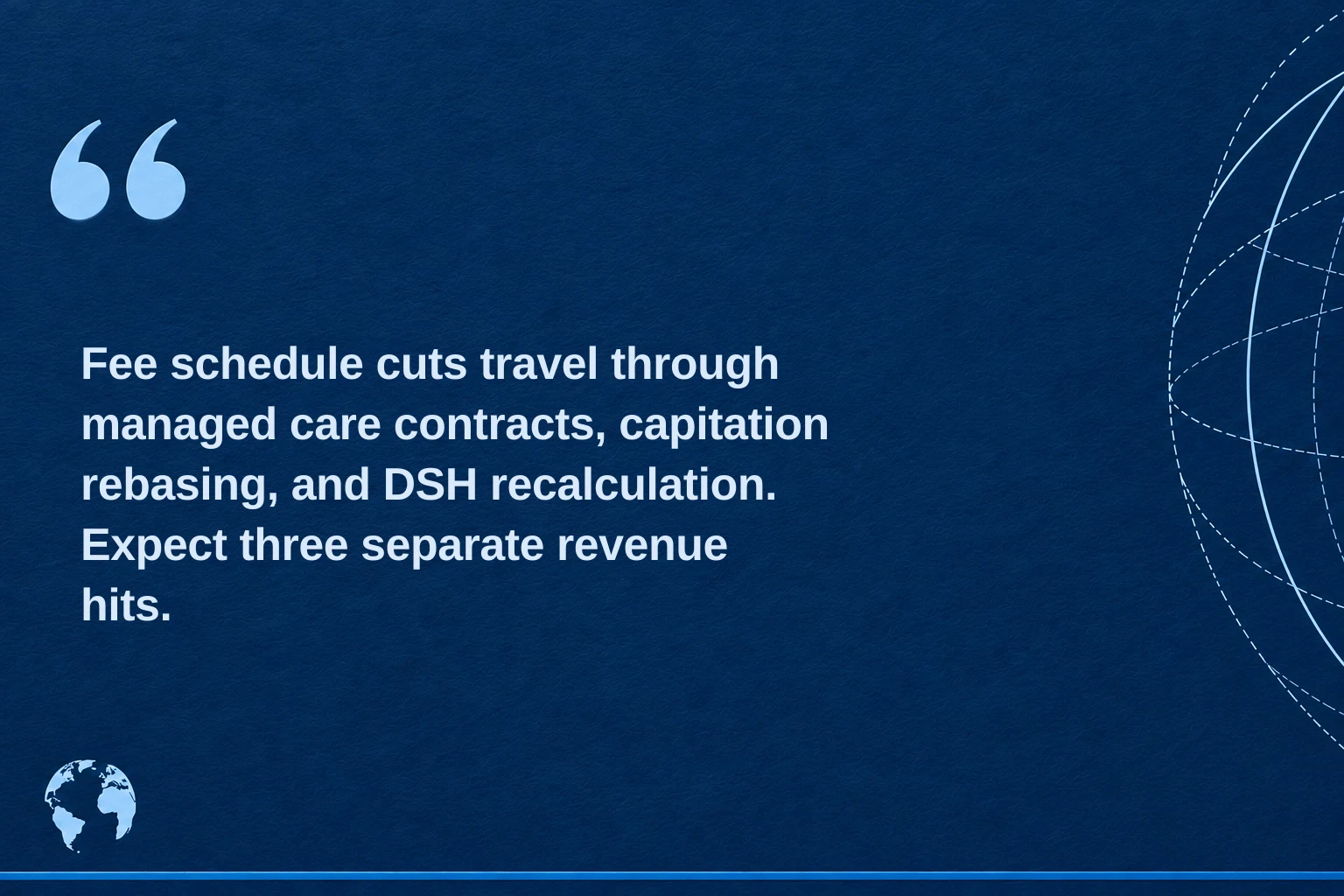
A state fee-for-service rate cut does not land cleanly inside a treatment center’s bank account. It travels through the Heritage Health managed care program (Nebraska Total Care, Healthy Blue, Molina), capitation rebasing, and the SPA or 1115 amendment CMS ultimately approves. According to the Nebraska Medicaid Annual Report, behavioral health accounts for 14.3% of Heritage Health services by relative cost, trailing pharmacy at 25.3%. That 14.3% share is the number your actuaries at the MCO are staring at when they build the next capitation rate cell.
Three transmission mechanisms operators should map:
- Fee schedule pass-through. Heritage Health contracts typically floor at the state Medicaid fee schedule. When MLTC lowers the floor, MCOs lower their provider contract amendments on the next renewal cycle. Expect 60 to 120 days of notice, not more.
- Capitation rebasing. Actuarial soundness reviews reset PMPM rates against the new fee schedule. Facilities on sub-capitation or case rate arrangements get re-negotiated downward even if their specific CPT rates don’t change.
- DSH and supplemental payment exposure. Disproportionate Share Hospital allotments and Upper Payment Limit (UPL) methodology calculations reset against the new base. Hospital-based BH units take a second hit through the DSH recalculation.
The Nebraska Hospital Association condemned the federal State Directed Payments restriction separately, warning that nearly half of our rural hospitals are currently operating in the red,
according to NHA President Jeremy Nordquist. Any PE-backed buyer looking at a Nebraska rural BH asset should price that NHA number into the quality-of-earnings workup, not the marketing deck.
The LB bills, the committees, and who is actually testifying
Operators tracking the 2026-2027 biennium need to watch the Appropriations Committee and the Health and Human Services Committee on the Nebraska Legislature calendar. Prior-session precedent matters here. Senator Myron Dorn’s LB 55 in the 2025 session appropriated $1,500,000 for FY 2025-26 as reimbursement to mental health providers who treat dual-eligible (Medicaid and Medicare) patients where the Medicare rate is lower than Medicaid. The enacted biennial budget funded LB 55 at $3,934,426 across Cash and Federal funds, and the same budget document shows Behavioral Health aid at $70,132,211 for FY 2025-26 and FY 2026-27.
What to pull from the public record this session:
- The LB-numbered Appropriations Committee bills touching Program 348 (Medicaid) and Program 038 (Behavioral Health aid). The Nebraska Legislature bill tracker publishes hearing calendars and transcripts.
- Nebraska Hospital Association and Nebraska Association of Behavioral Health Organizations (NABHO) written testimony. NHA’s Ivan Mitchell, Megan Chaffee, and Jeremy Nordquist have been the recurring voices at the podium.
- DHHS fiscal notes and the Nebraska Legislative Fiscal Office budget analyses, which project the downstream General Fund impact that drives senator vote math.
The Nebraska Examiner reported on November 23, 2026 that lawmakers are now actively deliberating next steps in response to the provider outcry. That window, between agency announcement and committee markup, is where operator comment actually moves a number.
Stress-test the pro forma: 3-5% and 7-10% scenarios
Here is a replicable scenario framework operators can run against their own Nebraska census and payer mix. Start with the SFY27 Nebraska Medicaid fee schedule as the baseline: Nebraska pays $118.37 for outpatient psychotherapy and diagnostic evaluation (6th of 34 state Medicaid programs tracked), $164.25 for H0031 mental health assessment, and $283.19 per day for psychiatric residential treatment.
Build the sensitivity table across three cases:
- Case A (announced 3-5% range). Apply a 3% reduction to each line, then layer the second 3% in the following fiscal year for a compounded 5.91%. On a 90-bed residential program at 85% occupancy, the daily rate drop from $283.19 to $266.46 equals roughly $466,000 in annual gross revenue, before MCO withhold.
- Case B (7-10% stress scenario). Model what happens if the Appropriations Committee adds federal pass-through reductions from the federal Medicaid bill NHA has been fighting. The combined state and federal exposure puts you at roughly 8-10% effective reduction.
- Case C (worst case). Layer in Heritage Health MCO withhold tightening, capitation PMPM re-basing lag, and the elimination of FY25-26 dual-eligible supplemental dollars that LB 55 created.
Run each case through a 12, 18, and 24-month revenue realization curve. Nebraska fee schedule changes typically hit fee-for-service claims within 30 to 60 days of the effective date, but MCO contract amendments and capitation re-basing lag 90 to 180 days. That lag is where operators get caught flat-footed because the P&L looks fine for two quarters before the trough hits.
For context on where facility margins already sit, NHA leadership has said publicly that nearly half of our rural hospitals are currently operating in the red.
If a behavioral health facility operator is modeling anything better than low-single-digit EBITDA margin on the Nebraska Medicaid book, the assumptions deserve a second look.

Frequently asked questions
Which Nebraska legislative bills and committee hearings should BH operators monitor this session?
Watch the Appropriations Committee and Health and Human Services Committee calendars on nebraskalegislature.gov. Track any LB-numbered bills referencing Program 348 (Medicaid) or Program 038 (Behavioral Health aid). The 2025 precedent, Senator Myron Dorn’s LB 55, is the template for how a targeted BH rate appropriation moves. Pull DHHS fiscal notes and Legislative Fiscal Office analyses on each bill; those drive vote math more than testimony does.
How do Heritage Health managed care contracts transmit state Medicaid rate cuts to behavioral health providers?
Three paths. First, contract floors that reference the state fee schedule drop automatically on the effective date, with Nebraska Total Care, Healthy Blue, and Molina pushing provider amendments within 60 to 120 days. Second, actuarial soundness reviews rebase the PMPM capitation cells, which pulls sub-capitation and case rate arrangements down even where CPT rates are unchanged. Third, MCO quality withhold programs tighten as the state squeezes administrative dollars.
What is the typical lag between a Nebraska Medicaid rate change and realized revenue impact at the facility level?
Fee-for-service claims reprice within 30 to 60 days of the effective date. MCO contract amendments usually hit at 90 to 180 days. Capitation rebasing on sub-cap arrangements can stretch to a full contract year. The practical effect is that the full P&L hit often doesn’t show up until the second or third quarter after the rate change.
How should operators stress-test a pro forma for a 5% versus 10% Nebraska Medicaid BH rate reduction?
Build a line-item sensitivity against the SFY27 fee schedule for your top five billed codes, weight by census and payer mix, then run 12, 18, and 24-month realization curves. At 5%, most facilities with Medicaid mix above 50% lose 2 to 3 points of EBITDA margin. At 10%, facilities below 55% Medicaid mix typically still survive; facilities above 70% Medicaid mix will need to cut labor hours, reduce census, or renegotiate real estate before the second fiscal year hits.
What role does the Nebraska 1115 SUD waiver play in insulating (or exposing) residential and PHP providers from state cuts?
The 1115 SUD waiver authorizes federal match for residential SUD treatment in IMD settings that would otherwise be excluded, which is the funding mechanism keeping many Nebraska residential beds economically viable. PHP (ASAM Level 2.5, an outpatient level of care) sits outside the IMD question entirely and is billed through standard outpatient Medicaid. If the state cuts the underlying fee schedule, the waiver’s federal match percentage doesn’t change but the base rate being matched falls, so the net federal dollars flowing to residential providers drop proportionally. Operators should pull the current waiver STCs from the CMS Medicaid.gov tracker and check renewal timing against the biennium budget window.
References
- Nebraska Public Media: ‘Death by 1,000 cuts’: Nebraska Medicaid providers brace for rate reductions
- Nebraska Examiner: Outcry over intended Medicaid cuts grabs lawmakers’ attention
- Nebraska Examiner: Nebraskans raise alarm about proposed $152 million cut to DHHS
- Nebraska Legislative Fiscal Office: FY2025-26 and FY2026-27 Biennial Budget
- Nebraska DHHS: Medicaid Annual Report 2025
- MedicaidRate: Nebraska Medicaid Fee Schedule and Reimbursement Rates (2026)
- MedicaidRate: Behavioral Health Medicaid Reimbursement Rates by State (2026)
- 1011 Now: Nebraska Hospital Association condemns new Medicaid funding reduction