



Table of Contents
Ready to See Results?
From strategy through execution, Atlantic Health Strategies integrates compliance, operations, and growth into durable, measurable results. Let’s put our expertise to work for your organization.
The Short Answer
Behavioral health operators in 2026 need a partner that owns the full credentialing and contracting sequence on a clock that matches NCQA’s July 1, 2025 tightening and CAQH’s 120-day re-attestation cycle. That means CAQH setup, primary source verification, payer applications, fee schedule review, effective-date confirmation, and monthly monitoring, run by a team that credentials SUD and mental health programs specifically. Generic medical billing vendors and solo-therapist software platforms will not do this at the depth an SUD or mental health facility needs.
Here is the practical reality. On July 1, 2025, NCQA cut the primary source verification window from 180 days to 120 days for accredited organizations, and from 120 days to 90 days for certified CVOs. Medicare and Medicaid exclusion checks, SAM.gov reviews, OIG queries, and applicable state board sanctions must also be conducted every 30 days, with findings escalated to a designated peer-review body, not just the credentialing committee. If your credentialing vendor is still operating on a six-month cadence with quarterly exclusion sweeps, your files will not survive a payer audit.
Atlantic Health Strategies runs the credentialing lifecycle for behavioral health and SUD programs in states like Florida, Texas, Arizona, and Tennessee. The work is sequential. Credentialing is verification. Contracting is agreement. Billing is what happens after both are right. Skip a step and revenue does not flow.
What Behavioral Health Credentialing Actually Involves in 2026

Credentialing for a behavioral health provider runs 90 to 180 days from application to effective date. Payers pull primary source verifications from licensing boards, schools, malpractice carriers, the National Practitioner Data Bank, and the OIG exclusion database. Any gap in work history, any missing attestation, any document mismatch resets the clock.
The CAQH ProView profile sits at the center of this. Relias reports more than 4.8 million provider records in the CAQH database, with 2.5 million providers having updated or attested their data in the last 120 days, and CAQH-participating organizations covering more than 300 million Americans. An incomplete or inaccurate profile delays every payer application simultaneously.
The 120-day re-attestation rule is the part most programs miss. Miss the deadline and the profile goes inactive, freezing every credentialing and re-credentialing process tied to it, and there is no warning email from the insurance company. AHS watched a Florida program lose six figures of billable revenue because a clinical director’s CAQH lapsed for 27 days while the leadership team was focused on a state survey. One lapse cascades across every payer that pulls the profile.
The credentialing packet a serious operator maintains for each provider includes:
- Individual NPI and organizational NPI Type II
- State licensure, DEA where applicable, and malpractice with required coverage limits
- Five years of work history with no unexplained gaps
- CAQH ProView profile with current re-attestation
- CARF or Joint Commission accreditation evidence for SUD programs
- Medicare enrollment through PECOS, Medicaid enrollment with the state agency and every MCO in the service area
Organizational credentialing runs in parallel with individual provider credentialing, and the two must be sequenced correctly or the effective dates will not line up. AHS starts credentialing work before a program’s doors open so revenue can flow from the first billable date.
Payer Contracting Is Where Programs Quietly Lose Years of Revenue
Credentialing is verification. Contracting is agreement. Most operators sign payer participation agreements without scrutinizing the fee schedule, timely filing windows, utilization management provisions, or audit rights, because the documents are dense and the team is eager to start billing.
The 2026 Medicare rates are now public. On October 31, 2025, CMS finalized the CY 2026 Physician Fee Schedule. Per the CMS fact sheet, “the final CY 2026 nonqualifying APM conversion factor of $33.40 represents a projected increase of $1.05 (+3.26%) from the current conversion factor of $32.35,” with the qualifying APM conversion factor set at $33.57 (+3.77%). Most commercial behavioral health contracts benchmark off Medicare, so a 3% conversion factor move ripples through annual revenue more than most operators model.
McDermott+ notes that CMS also finalized a 2.5% efficiency adjustment for all codes except those specifically excluded, which include time-based codes, services on the telehealth list, and maternity care codes with an MMM global period. That protects most psychotherapy CPTs, which are time-based. It does not protect every code you bill.
Commercial pays more than Medicare for the same CPTs, but commercial contracts carry harder prior authorization, more aggressive utilization management, and audit exposure that programs underestimate. A Florida IOP AHS worked with last year signed three commercial contracts at rates 22% below market because nobody on their side read the fee schedule attachment before signing. Our team renegotiated two and exited one. The swing was $480,000 annually on the same census.
Joining every panel is not a strategy. Operators who build a defined commercial mix and a deliberate Medicaid approach outperform operators who took every contract that arrived in the inbox.
Why SUD Programs Face the Hardest Credentialing Environment
Addiction treatment operators sit inside a payer environment nobody else has to manage. Dual state licensing and federal certification through SAMHSA. ASAM Criteria 4th Edition levels of care that map to H-codes, T-codes, and per diem structures depending on the payer. Managed behavioral health carveouts that sit between you and the commercial plan you thought you contracted with.
Medicaid is the bigger issue. Per KFF, comprehensive, capitated managed care accounts for about 78% of beneficiaries (over 66 million individuals as of July 2024) and 50% of total Medicaid spending (over $458 billion in FY 2024), with states contracting with over 290 individual Medicaid MCOs. Enroll with the state Medicaid agency only and you are locked out of the majority of your Medicaid-eligible census. Each MCO runs its own credentialing process. Each one pays at rates it negotiates inside the state contract.
On the commercial side, operators credential with UnitedHealthcare for medical and never separately credential with Optum Behavioral Health, then discover the gap when SUD claims start denying. Magellan, Optum, Carelon, and the BCBS behavioral carveouts all run their own panels. A Texas residential program AHS onboarded last year had been billing six months before anyone on that team realized their MAT services were going to a carveout they had never applied to.
Re-credentialing and maintenance is where most programs lose ground after a strong initial credentialing push. Per Neolytix’s breakdown of NCQA’s July 2025 standards, NCQA requires providers to be recredentialed every 36 months from the last approval date, on a fixed documented cycle initiated 90 to 120 days in advance, with monthly exclusion checks escalated to a peer-review body when issues surface. Miss the cycle and the panel disenrolls the provider without any notification that lands in your inbox.
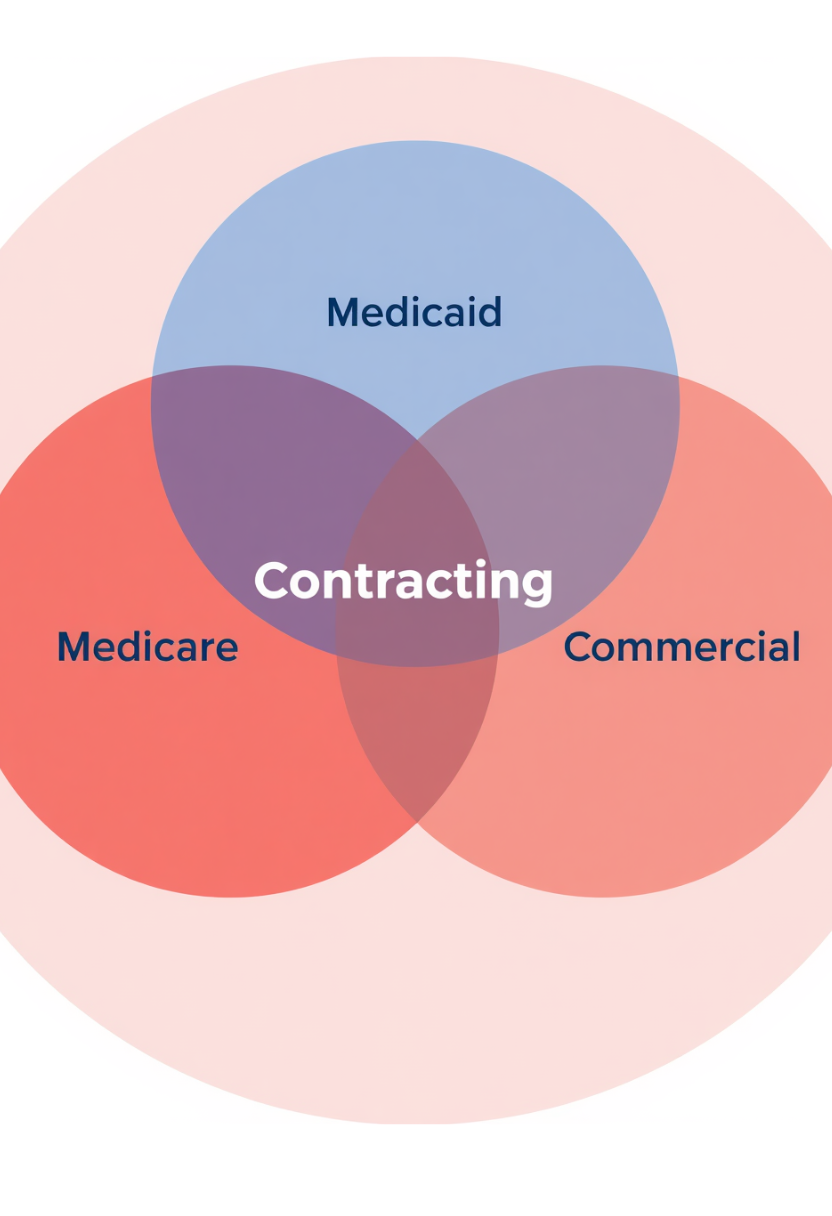
How to Evaluate a Credentialing and Contracting Partner
The market splits into three groups. Software-only platforms that require your staff to do the work. Generalist medical billing companies that treat behavioral health credentialing as an afterthought. Full-service firms that own the process from CAQH setup through effective date and ongoing maintenance.
When you evaluate a partner, ask these questions and demand specifics:
- Behavioral health depth. Do they credential SUD programs separately from commercial mental health? Do they know which states require dual licensure and which require SAMHSA certification?
- NCQA timeline compliance. Are they operating inside the new 120-day window? Are Medicare and Medicaid exclusion checks, SAM.gov reviews, OIG queries, and applicable state board sanctions conducted every 30 days, with findings escalated to a designated peer-review body? Confirm they do this.
- Contract review, not just credentialing. Will they read your fee schedules, flag the timely filing language, and tell you which payer is pushing through utilization management terms that will bury you?
- Maintenance ownership. Who is watching CAQH attestation dates, license renewals, DEA renewals, and provider terminations? If the answer is your office manager, you have a problem.
ProviderTrust described the NCQA overhaul as raising “the bar for credentialing processes, calling for decreased verification windows and increased monitoring”. The audit posture just got tighter, and vendors who used to coast on quarterly sweeps are going to fail your next survey.
Atlantic Health Strategies works from the operator side of this. AHS is the team programs call when an MCO audit lands, when a commercial payer disenrolls a provider mid-cycle, or when a founder realizes the IOP they opened nine months ago has been collecting 31% of what it should be on the same volume. Credentialing and contracting cannot be separated. AHS does both, and does the maintenance after.
Frequently asked questions
How long does behavioral health credentialing take in 2026?
Initial credentialing runs 90 to 180 days from application to effective date, depending on payer, provider type, and documentation completeness. As of July 1, 2025, NCQA shortened its primary source verification window: accredited organizations must complete verification within 120 days, and certified CVOs within 90 days, down from 180 and 120 respectively (ProviderTrust). Programs still operating on the old six-month cadence will fail payer audits.
What happens if a provider’s CAQH ProView re-attestation lapses?
CAQH ProView requires re-attestation every 120 days. Miss the deadline and the profile goes inactive, freezing every credentialing and re-credentialing process tied to it, with no warning email from the insurance company (HireGaynell). With more than 4.8 million provider records in the CAQH database and CAQH-participating organizations covering more than 300 million Americans (Relias), a single lapse cascades across every panel a provider participates in.
Do I need to credential separately with Medicaid managed care plans?
Yes. Per KFF, comprehensive capitated managed care accounts for about 78% of Medicaid beneficiaries (over 66 million individuals as of July 2024) and 50% of total Medicaid spending (over $458 billion in FY 2024), with states contracting with over 290 individual Medicaid MCOs. Enrolling with the state Medicaid agency alone is not enough. Each MCO in your service area runs its own credentialing process, its own network, and its own rate schedule. Missing MCO enrollment locks a program out of the majority of its Medicaid-eligible census.
How does the 2026 Medicare conversion factor affect behavioral health contract rates?
On October 31, 2025, CMS finalized a CY 2026 non-QP conversion factor of $33.40, a 3.26% increase from the 2025 rate of $32.35, and a QP conversion factor of $33.57, a 3.77% increase (CMS fact sheet). Behavioral health time-based codes, including most psychotherapy CPTs, are exempt from the 2.5% efficiency adjustment CMS applied to non-time-based services, along with services on the telehealth list and maternity care codes with an MMM global period (McDermott+). Because most commercial behavioral health contracts benchmark off Medicare, the conversion factor move flows into commercial rate resets throughout 2026.
References
- CMS: Calendar Year (CY) 2026 Medicare Physician Fee Schedule Final Rule (CMS-1832-F) Fact Sheet
- ProviderTrust: Unpacking the 2025 NCQA Credentialing Guideline Updates
- Neolytix: NCQA Credentialing Standards Explained (July 2025 Updates)
- KFF: Medicaid Managed Care Reporting and Transparency (July 2024 data)
- Relias: What is CAQH? Basics + Credentialing
- HireGaynell: CAQH ProView Re-Attestation, the 120-Day Rule and Avoiding Lapses
- McDermott+: CMS Releases CY 2026 Physician Fee Schedule Final Rule