



Table of Contents
Ready to See Results?
From strategy through execution, Atlantic Health Strategies integrates compliance, operations, and growth into durable, measurable results. Let’s put our expertise to work for your organization.
The five risks that actually hit behavioral health operators
Behavioral health organizations carry a heavier cyber load than most hospitals and run leaner IT to carry it. You hold HIPAA PHI under the HIPAA Security Rule at 45 CFR Part 164 Subpart C, 42 CFR Part 2 substance use disorder records, payer and financial data, and often e-prescribing records tied to the DEA’s EPCS requirements under the Ryan Haight Act. The five risks that cause the most operator pain, in order: ransomware that halts admissions and billing, business email compromise against finance and intake, breaches at your EHR or RCM vendor, misconfigured telehealth and patient portals, and insider access to Part 2 records by staff who should have been offboarded.
The money backs this up. The average cost of a healthcare data breach reached $9.77 million in 2024, roughly 2.5x the cross-industry mean, with an average cost per record of $429. Healthcare breaches typically run 213 days before discovery. If you are a 120-bed residential operator in Florida or a multi-site IOP group in Texas, that is not a hospital-only problem. That is your problem.
What OCR and the HHS breach portal are telling us
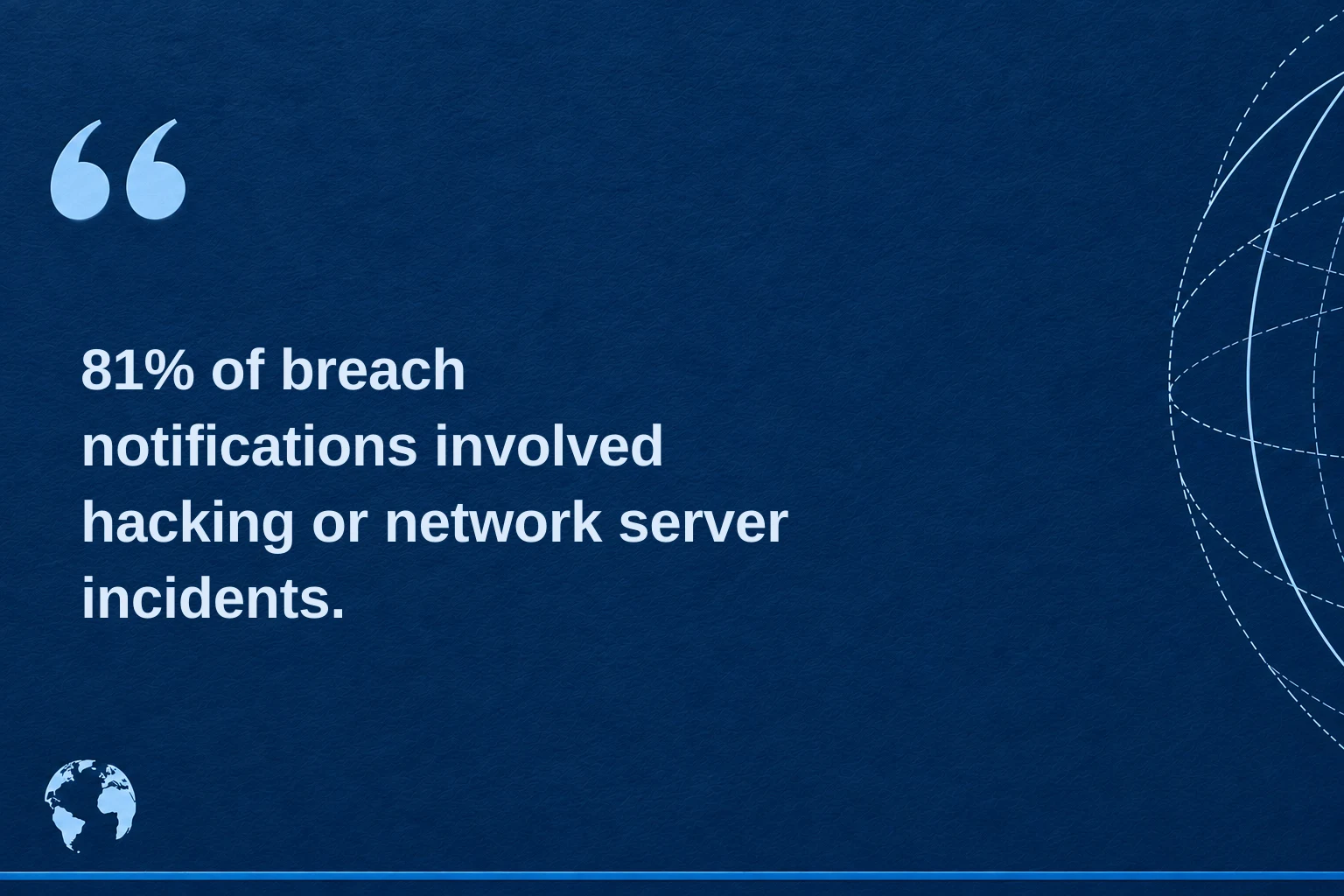
The HHS Office for Civil Rights publishes every breach of 500 or more records on its public portal, which exists under the HITECH Act. The 2024 numbers are the ones to internalize. OCR received 663 notifications of breaches of unsecured PHI affecting 500 or more individuals that occurred during 2024, with hacking and IT incidents involving a network server accounting for 534 of them, 81% of total breach reports, and 241,582,022 affected individuals. OCR took 21 enforcement actions in 2025, its second highest annual total, up from 16 in 2024.
Read the resolution agreements posted on the OCR enforcement page and the same five findings show up over and over: no current risk analysis, no risk management plan tied to that analysis, no information system activity review, weak audit controls, and sloppy authentication. The settlements are not abstract. In 2024 OCR settled with Montefiore Medical Center for $4,750,000, Solara Medical Supplies for $3,000,000, and Heritage Valley Health System for $950,000. If your behavioral health organization cannot produce a current NIST SP 800-66 Rev. 2-aligned risk analysis on request, you are already underwater.
Vendor and third-party risk is now the main attack surface
The EHR, the clearinghouse, the RCM partner, the telehealth platform, the billing BPO in another country. Every one of them is a path into your records. Verizon’s data is blunt on this. Breaches with third-party involvement have increased by 60% from last year’s dataset, reaching 48% of total breaches in the 2026 DBIR. Verizon’s data includes 1,710 security incidents at healthcare organizations and 1,542 healthcare breaches, with system intrusions overtaking miscellaneous errors as the dominant pattern.
Change Healthcare is the cautionary tale operators keep underestimating. The largest single report on the OCR register is Change Healthcare, Inc. In 2024, affecting 192,700,000 individuals, reported as a hacking/IT incident. If your clearinghouse goes down for three weeks, your cash stops. If your EHR vendor is breached, you still own the HIPAA notice to patients and the state AG filings. Your Business Associate Agreement should specify breach notification timing, SOC 2 Type II evidence, subcontractor disclosure, and indemnification that actually covers forensics and notification costs. Most of the BAAs I review during M&A diligence do none of this.
A control list a non-technical COO can actually run
Stop buying tools and start building the program. The HHS 405(d) Health Industry Cybersecurity Practices (HICP) for Small and Medium Organizations is the right scaffolding, and it maps cleanly to NIST CSF 2.0. If you operate 50 to 200 beds across multiple states, these are the minimum controls I expect to see on the first day of an engagement:
- Current risk analysis and risk management plan tied to NIST SP 800-66 Rev. 2, refreshed at least annually and after any material system change.
- MFA on everything: EHR, email, VPN, RCM portals, payer portals, admin consoles. No exceptions for the CEO.
- Email security that catches BEC against finance and intake, with a documented wire verification protocol that requires a callback to a known number.
- Offboarding SLA under 15 minutes for EHR, email, and remote access when a clinician or admin is terminated, with evidence of the audit log review.
- Immutable, segregated backups tested quarterly, with a documented recovery time objective your CFO has actually seen.
- Vendor inventory with current BAAs, SOC 2 reports, and a tiered risk rating for every vendor that touches PHI or Part 2 records.
- Part 2 access controls that distinguish SUD records from general PHI inside the EMR, because SAMHSA’s 42 CFR Part 2 consent and redisclosure rules are stricter than HIPAA.
- Incident response plan with named roles for legal, PR, IT, and compliance, tested with at least one tabletop a year.
As CISA’s Healthcare and Public Health Sector guidance puts it, “Credential theft was the most common method of breaching networks and was the initial access vector in 38% of all data breaches, followed by phishing.” That is why MFA and offboarding sit at the top of the list, not endpoint detection.

Frequently asked questions
Does 42 CFR Part 2 require stricter breach handling than HIPAA for SUD records?
Yes, in practice. Part 2 adds consent, redisclosure, and prohibition-on-use requirements that HIPAA does not impose, and the 2024 final rule aligned Part 2 breach notification with HIPAA while preserving Part 2’s heightened confidentiality standard. If a breach exposes Part 2 records, your notice content and your internal investigation have to address both regimes. Treating Part 2 as “HIPAA-plus” during incident response is the right default.
What cybersecurity documentation will a payer, Joint Commission, or CARF surveyor actually ask to see?
Expect requests for your current risk analysis, risk management plan, information security policies, workforce training records, BAAs for every PHI-handling vendor, incident response plan with evidence of testing, audit log review evidence, and your termination and access-review procedures. Payer SIU audits increasingly ask the same questions. If you cannot produce these in a mock survey window, you will not produce them in the real one.
Who is liable when our EHR or RCM vendor is breached, the vendor or us?
Both, but the patient notification obligation under the HIPAA Breach Notification Rule sits with you as the covered entity unless the BAA specifically delegates it and the vendor actually performs. OCR has settled with covered entities for business associate failures. Your BAA is the only lever that moves cost, timing, and indemnification. Read it before you sign it, not after the breach.
What are the minimum controls a 50 to 200 bed behavioral health operator should have in place?
The HHS 405(d) HICP small and medium practice guide is the right baseline. At a minimum: MFA everywhere, email security, current risk analysis, offboarding under 15 minutes, immutable tested backups, a vendor inventory with current BAAs, Part 2 access segregation inside the EMR, and a tested incident response plan with named roles.
How do cybersecurity gaps surface during PE diligence and what kills deal value?
Buyers ask for the risk analysis, the penetration test, the SOC 2 reports from your EHR and RCM vendors, OCR correspondence, prior breach notifications, and your cyber insurance application and claims history. Missing risk analysis, open OCR matters, unpatched legacy EMR servers, and a BAA inventory that cannot be produced on request all trigger escrow holdbacks or purchase price reductions. In one Georgia deal, a missing risk analysis and an unresolved OCR matter from a prior business associate incident took roughly $1.2 million out of the equity bridge at close. The buyer did not walk, but the sellers paid.
References
- HHS OCR, Annual Report to Congress on Breaches of Unsecured Protected Health Information (2024)
- HHS OCR Breach Portal (“Wall of Shame”)
- HHS OCR Resolution Agreements and Civil Money Penalties
- HHS 405(d) Health Industry Cybersecurity Practices (HICP) for Small and Medium Organizations
- NIST SP 800-66 Rev. 2, Implementing the HIPAA Security Rule
- NIST Cybersecurity Framework 2.0
- Verizon 2026 Data Breach Investigations Report, Healthcare Snapshot
- HIPAA Journal, 2024 Healthcare Data Breach Report
- SAMHSA, 42 CFR Part 2 Confidentiality Regulations
- CISA Healthcare and Public Health Sector Resources