



Table of Contents
Ready to See Results?
From strategy through execution, Atlantic Health Strategies integrates compliance, operations, and growth into durable, measurable results. Let’s put our expertise to work for your organization.
The answer, in one paragraph
Behavioral health treatment centers close staffing gaps when their leaders stop treating recruitment as an HR problem and start treating it as a regulatory, financial, and licensure problem at once. The supply gap is real and federally documented: HRSA’s National Center for Health Workforce Analysis projects six-figure shortfalls across every major clinical discipline. HRSA projects shortfalls of roughly 99,840 psychologists, 99,780 mental health counselors, 77,050 addiction counselors, and 36,780 adult psychiatrists by 2038. Operators who hire against that gap do four things in parallel: they qualify their sites for NHSC loan repayment, they recruit across state lines using the Counseling Compact and Social Work Compact, they build tiered care teams around peer support and bachelor’s-level staff instead of chasing scarce master’s-level clinicians, and they benchmark compensation against state Medicaid rate studies and BLS OEWS wage data, not against what the facility down the street paid last year.
What the HRSA, SAMHSA, and HPSA numbers actually mean for your pro forma
If you are modeling census and clinical FTEs for a new site, the shortage data is not background noise. It is a direct input to your pro forma. More than 122 million Americans live in Mental Health Professional Shortage Areas. By 2037, the Health Resources and Services Administration projects shortages of nearly 88,000 mental health counselors and 114,000 addiction counselors.
The HPSA designation is not just a map. It is the gating criterion for most federal workforce dollars that flow to your site. HRSA’s Designated HPSA Quarterly Report shows 26.4% of need met in shortage areas, which is both the problem and the opening. A site sitting inside a qualifying HPSA, or inside an NHSC-approved SUD treatment facility designation, becomes meaningfully more hireable overnight.
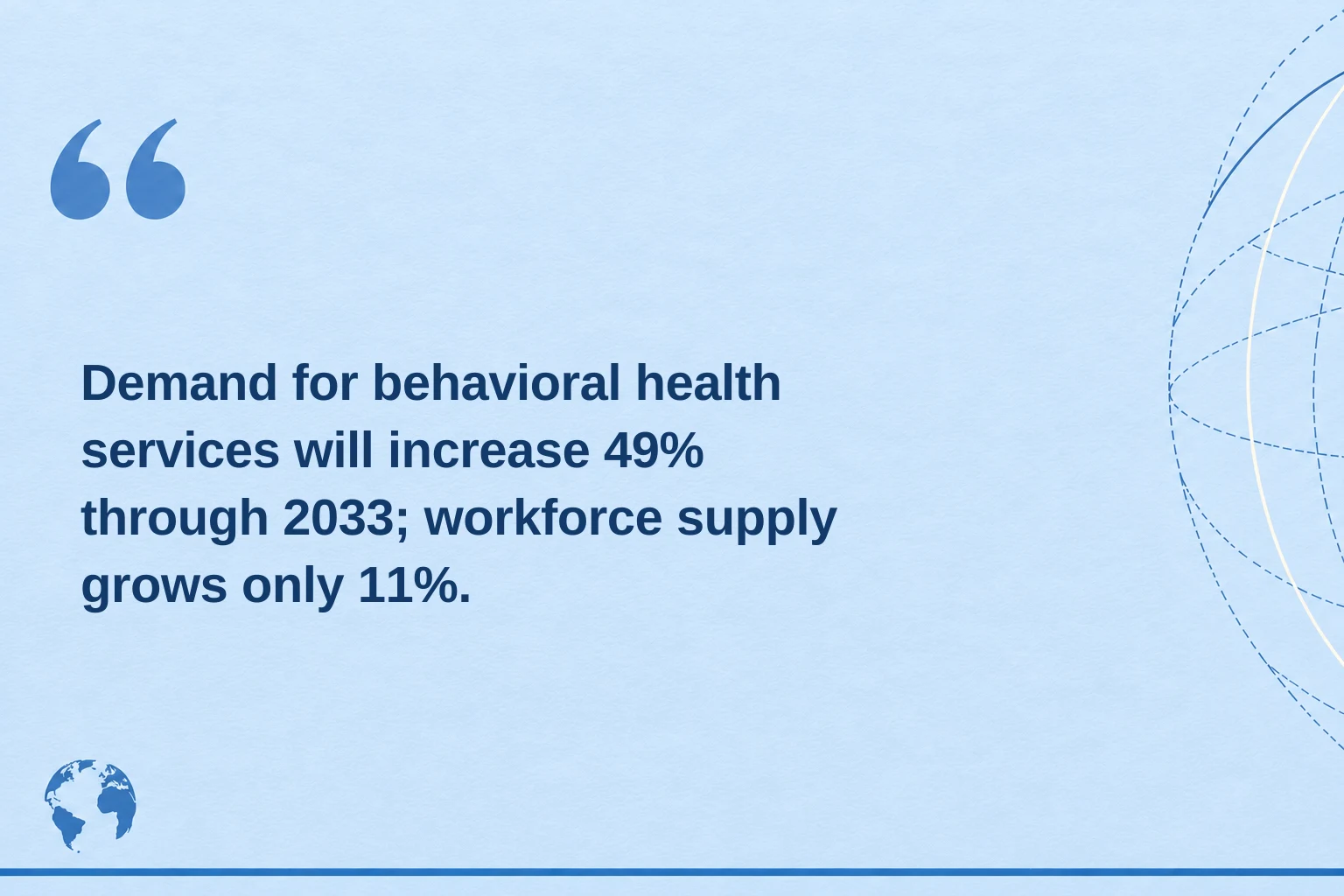
Two operator takeaways. First, when I review feasibility studies for a Texas, Florida, or Montana project, I pull the HPSA score for the exact census tract before I sign off on the staffing model. If the score does not support NHSC eligibility, the recruitment timeline in the pro forma gets longer and the wage line gets heavier. Second, the demand curve is not flattening. HRSA projections indicate demand for behavioral health services will increase by 49% through 2033, while workforce supply is projected to grow by only 11% over the same period. Build your five-year staffing model to that reality, not to last year’s.
NHSC loan repayment is the most underused recruiting tool in behavioral health
Most operators I talk to have heard of NHSC. Very few have actually gotten their site approved, trained their recruiters on it, or built it into offer letters. That is money (and clinicians) left on the floor.
The current award structure is specific. The NHSC Loan Repayment Program offers up to $75,000 full-time for primary care medical and up to $50,000 full-time for dental or behavioral health, in exchange for two years at an NHSC-approved site. For SUD treatment facilities, the award ceiling is higher: clinicians receive funds to repay outstanding qualifying educational loans for a three-year service obligation, and NHSC loan repayment funds are exempt from federal income and employment taxes, up to $75,000 full-time. The NHSC Rural Community Loan Repayment Program pushes awards up to $100,000 for three years at a rural NHSC-approved SUD site, and STAR LRP can go higher for six-year commitments.
The SUD program has a quiet but important eligibility expansion that most operators miss. Clinicians may qualify even if they work at a SUD treatment facility with a HPSA score that would ordinarily be too low to qualify for NHSC funding, using either the mental health or primary care HPSA score of their NHSC-approved SUD treatment facility. That expands the pool of eligible sites meaningfully. If you run an opioid treatment program, a residential SUD facility, or an outpatient SUD clinic, your HR team should know the exact SUD and MH HPSA scores for every physical site you operate, and your offer letters to LCSWs, LPCs, LMFTs, LADCs, and prescribers should name the loan repayment opportunity on page one.
Interstate compacts, tiered care teams, and compensation benchmarking
The Counseling Compact is operational, not theoretical. Counseling Compact privileges are live in a growing roster of states. The Compact is an interstate agreement that lets counselors practice in other member states through a privilege to practice instead of getting a separate license, and as of September 2026, nine states issue Counseling Compact privileges through CompactConnect (Arizona, Arkansas, Georgia, Indiana, Louisiana, Minnesota, Ohio, Tennessee, Wyoming) at $55 to $280 per privilege. The Social Work Compact, developed through ASWB, is moving on a similar track for LCSWs. If your organization operates in Georgia or Arizona and your recruiters are only sourcing in-state LPCs, you are hiring with one hand tied behind your back.
Tiered care teams relieve pressure on master’s-level clinicians. The scarcest resource is the licensed master’s-level clinician: the LCSW, LPC, LMFT, LADC. Operators who scale sustainably build layered teams around them. Peer recovery support specialists, certified behavioral health technicians, bachelor’s-level case managers, and psychiatric nurse practitioners (where state scope allows) absorb documentation, groups, care coordination, and prescribing load. That protects the master’s clinicians for the medical necessity work the ASAM criteria and your payer contracts actually require.
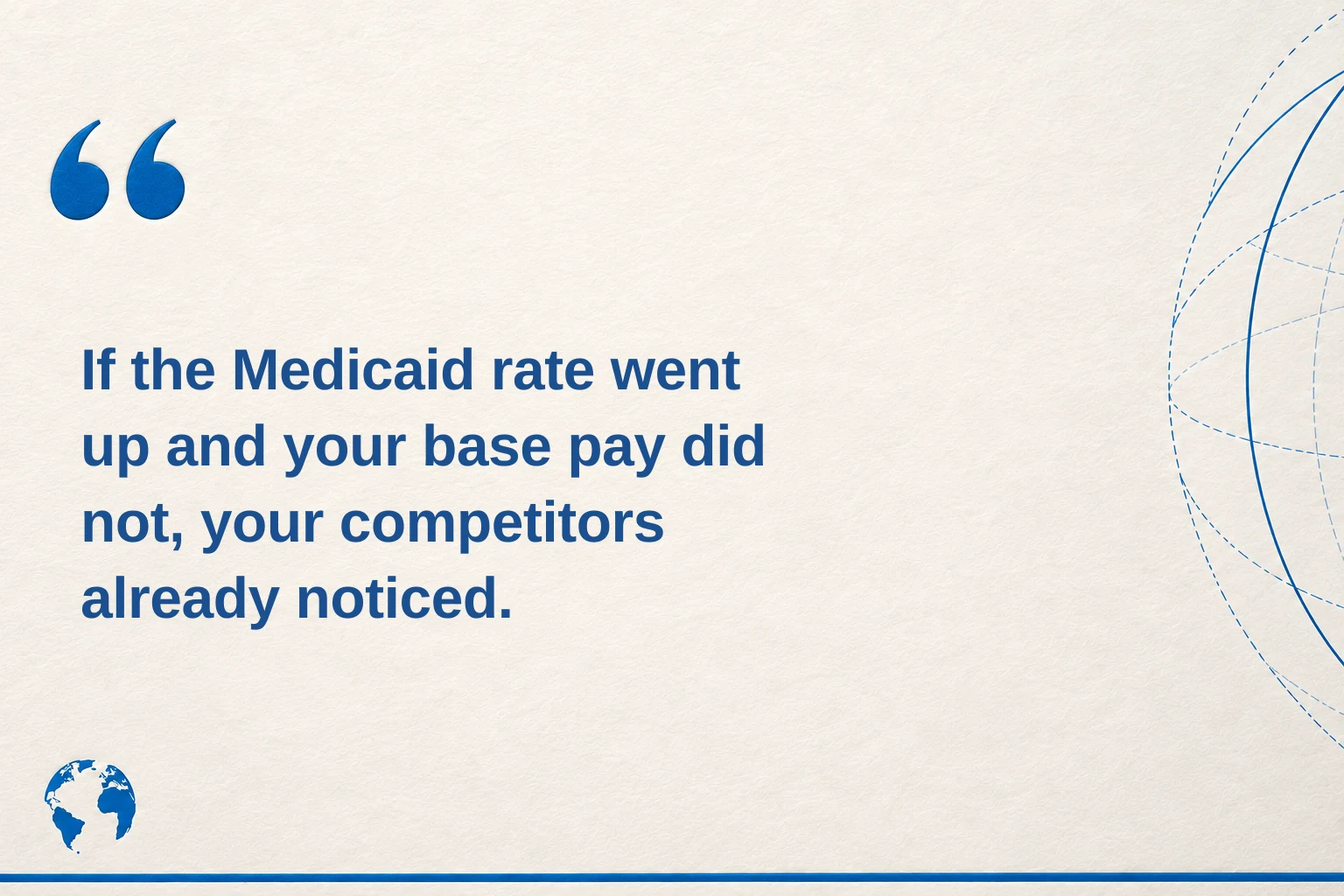
Benchmark compensation against both BLS and your state’s Medicaid rate study. The national median salary for Substance Abuse, Behavioral Disorder, and Mental Health Counselors is $59,342 per year, or $28.53 per hour, according to BLS OEWS, but state medians diverge sharply: the top 10% earn $97,590 and the bottom 10% near $38,940 (BLS OEWS, May 2025). The operators I advise across Texas, Florida, Georgia, and Montana who keep clinicians past the two-year mark are the ones who have mapped their pay bands against both the state OEWS percentile curve and the most recent state Medicaid behavioral health rate study published by their state Medicaid agency (and reviewed by CMS). If the Medicaid rate for H0015 or H0019 went up and your base pay did not, your competitors already noticed.
As the HRSA summary report notes, the shortage of a qualified and experienced behavioral health workforce is “exacerbated by high turnover rates, a lack of professionals, aging workers, and low compensation.” Three of those four are inside your control as an operator.
Frequently asked questions
What are the hardest clinical roles to fill in a residential SUD or mental health program right now?
Across the AHS client base, the three roles that consistently take longest to fill are psychiatric prescribers (psychiatrists and PMHNPs who will cover 24/7 call), bilingual master’s-level clinicians, and overnight RNs for residential detoxification (ASAM Level 3.7, residential withdrawal management under the 4th Edition). Prescribers are the hardest, and the HRSA data explains why: HRSA expects psychiatrist supply to decline as retirements outpace new entrants, even though the 2023 baseline stood at 52,164 psychiatrists, 104,012 doctoral psychologists, and 154,019 mental health counselors.
How can operators use NHSC loan repayment to recruit and retain clinicians?
First, get the site NHSC-approved. Then publish the loan repayment opportunity in every job posting and offer letter, with the specific dollar amount. For SUD treatment sites, the SUD Workforce LRP offers up to $75,000 for three years and the Rural Community LRP goes up to $100,000, and award preference is available to applicants who provide evidence-based Medications for Opioid Use Disorder (MOUD) treatment at NHSC-approved SUD facilities receiving Rural Communities Opioid Response Program funds, or those who possess specialized training to deliver substance use disorder treatment services. Track application cycles and build them into your hiring calendar.
Do the Counseling Compact and Social Work Compact let me hire clinicians licensed in other states?
Yes, if both the home state and the practice state are member states and the privilege is active. By April 2026, 38 states and the District of Columbia had enacted compact legislation, and Arizona, Minnesota, Ohio and Louisiana had begun granting privileges. Enactment is not the same as operational, so verify current privilege status through CompactConnect before you extend an offer that assumes portability.
What staffing ratios do CARF, Joint Commission, and state ASAM regulations actually require?
CARF and The Joint Commission do not publish rigid staff-to-patient ratios the way nursing home regulations do. They expect you to define, justify, and consistently meet your own ratios based on the acuity and level of care you deliver. State ASAM-aligned regulations are where the hard minimums live, and they vary: Texas HHSC, Florida DCF, and Montana BHDD each publish specific minimums for residential SUD, PHP (ASAM Level 2.5, which is outpatient), and IOP. For OTPs, 42 CFR Part 8 governs federal staffing and medical director requirements. Build your staffing matrix off the strictest standard that applies, then stress-test it in a mock survey before your actual survey window.
How should I benchmark clinician compensation against regional Medicaid rates and competitors?
Pull three data sets: BLS OEWS for your MSA by occupation code (21-1018 for counselors, 21-1023 for mental health and substance abuse social workers, 29-1223 for psychiatrists), your state Medicaid agency’s most recent behavioral health rate study, and competitor job postings scraped quarterly. Set base pay at the 60th to 75th percentile of OEWS for roles you cannot afford to lose, and model the margin impact of a 5 to 10 percent wage increase against your Medicaid revenue per encounter. If the math does not work, the problem is your payer mix, not your HR budget.
References
- HRSA Bureau of Health Workforce, National Center for Health Workforce Analysis: Health Workforce Projections
- National Council for Mental Wellbeing: A Workforce Under Pressure
- NHSC Substance Use Disorder Workforce Loan Repayment Program
- HRSA Bureau of Health Workforce: Loan Repayment Programs for Health Careers
- BLS OEWS Wage Benchmarks, Substance Abuse, Behavioral Disorder, and Mental Health Counselors (21-1018)
- Counseling Compact: Live Privilege States, 2026
- ASPE: Health Care Workforce. Key Issues, Challenges, and the Path Forward
- AHRQ Academy: Updated Behavioral Health Workforce Projections