



Table of Contents
Ready to See Results?
From strategy through execution, Atlantic Health Strategies integrates compliance, operations, and growth into durable, measurable results. Let’s put our expertise to work for your organization.
The six states operators should short-list in 2026
Florida, Texas, Arizona, Colorado, Tennessee, and North Carolina are the states where we see experienced behavioral health operators actually breaking ground in 2026. The shared traits: a Certificate of Need (CON) regime that either does not touch psychiatric or SUD beds or exempts them, a licensing agency with a published rule set operators can actually plan against, an approved Section 1115 SUD demonstration or equivalent Medicaid pathway, and documented unmet demand that payers are willing to fund.
Picking a state is really five decisions stacked on top of each other: Does CON apply to the level of care you want to open? How long does licensure take and who is the licensing agency? What does the Medicaid and commercial mix look like for that level of care? Is the workforce there? And is the sub-market already saturated? Get any one of those wrong and your pro forma is fiction.
A quick orientation on CON. NCSL counts 35 states and Washington, D.C. With active Certificate of Need programs, and the Cicero Institute’s 2024 50-state ranking found that many of those states carve behavioral inpatient out of CON entirely or specifically exempt mental health and SUD services. That exemption is the difference between opening in 14 months and opening in 36. On a 60-bed residential project carrying roughly $180,000 a month in pre-revenue debt service and facility carry, those extra 22 months are the model. That is not a rounding error. That is the deal.
How each of the six states actually scores: CON, licensing agency, code citation
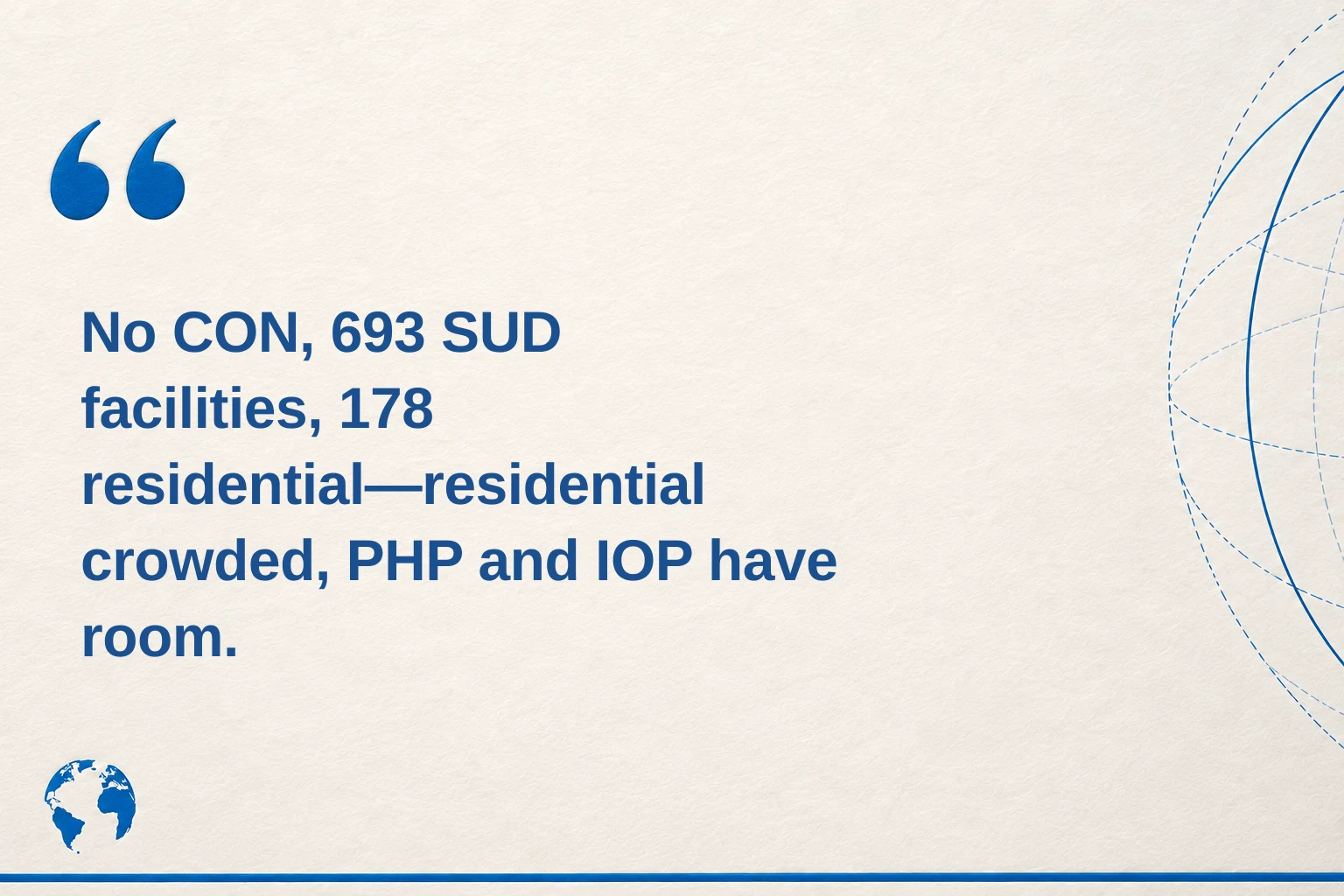
Florida. Licensure for SUD treatment runs through the Department of Children and Families under Chapter 65D-30, Florida Administrative Code, and mental health licensure runs through AHCA. Florida does not apply CON to most behavioral health projects, which is why KFF’s 2024 count shows Florida with 693 substance use treatment facilities, including 178 residential and 586 outpatient. Translation: residential is crowded in South Florida, but PHP, IOP, and OTP still have room, especially in the I-4 corridor and the Panhandle.
Texas. Behavioral health licensing is handled by Texas HHSC under 26 TAC Chapter 564 for chemical dependency treatment facilities (migrated from the old 25 TAC 448). No CON. The commercial payer book in Dallas, Austin, Houston, and San Antonio is genuinely attractive, with in-network commercial PHP per diems commonly landing in the $450 to $650 range depending on carrier and market. Expect licensure to take six to nine months if your application is clean.
Arizona. AHCCCS runs one of the most mature Medicaid behavioral health systems in the country, and ADHS licenses behavioral health residential and outpatient under A.A.C. Title 9, Chapter 10. Arizona already has 540 SUD treatment facilities (123 residential, 439 outpatient), so operators are really deciding between Phoenix (saturated residential, strong outpatient) and Tucson or Prescott (still underserved on PHP/IOP).
Colorado. The Behavioral Health Administration (BHA) consolidated licensure under 2 CCR 502-1, which is the single most important regulatory reform for operators in that state in a decade. No CON. Workforce is tight, however, and commercial reimbursement for residential has softened since 2022.
Tennessee. TDMHSAS licenses under Rule 0940, and as NCSL has documented, Tennessee exempted mental health facilities from CON approval. Demand side is real: KFF’s CDC WONDER analysis put Tennessee’s opioid overdose death rate at 26.1 per 100,000, well above the national average.
North Carolina. DHSR licenses mental health, DD, and SUD facilities under 10A NCAC 27G. North Carolina does still have an active CON program and strict corporate practice of medicine laws, so psych bed expansions can get hung up, but outpatient MH/SUD, PHP, and OTP generally proceed without CON. Medicaid expansion plus the state’s tailored plans has meaningfully changed the payer math since 2023.
What the demand data actually says in 2024-2025
Two data points are worth printing out and taping to the wall before you pick a state. First, CDC NCHS reported 80,391 provisional drug overdose deaths in 2024, down 26.9% from 110,037 in 2023. Demand is still enormous, but the curve is bending, and the operators who built pro formas on 2021-2022 overdose rates are now missing census. We have seen 90-bed residential programs run 55% occupancy for two straight quarters in markets that were full in 2021. That is a $4M revenue miss on a single program.
Second, the SAMHSA facility universe is bigger than most founders assume. The 2024 N-SUMHSS counted 15,953 substance use treatment facilities and 14,091 mental health treatment facilities nationally, with roughly nine out of ten SU facilities operated by private organizations. Private operators are the market. That also means greenfield entry is a fight for referral relationships and payer slots, not a fight for an empty market.
State-level nuance matters. KFF’s CDC WONDER data shows West Virginia at a 38.6 per 100,000 opioid overdose death rate in 2024, the highest in the nation, while Nebraska sat at 3.3. West Virginia looks like an obvious opportunity on a demand chart, but it is a CON state with a thin commercial book, a shrinking population, and limited LCSW and psychiatric NP supply. High demand does not equal good market. That is the whole operator thesis in one sentence.
Where operators go wrong: picking the state before picking the level of care
Every week we see a founder walk in with a state picked and a level of care still undecided. Reverse it. Residential SUD, PHP, IOP, OTP, and withdrawal management each have different CON exposure, different licensing timelines, different workforce requirements, and different payer behavior inside the same state.
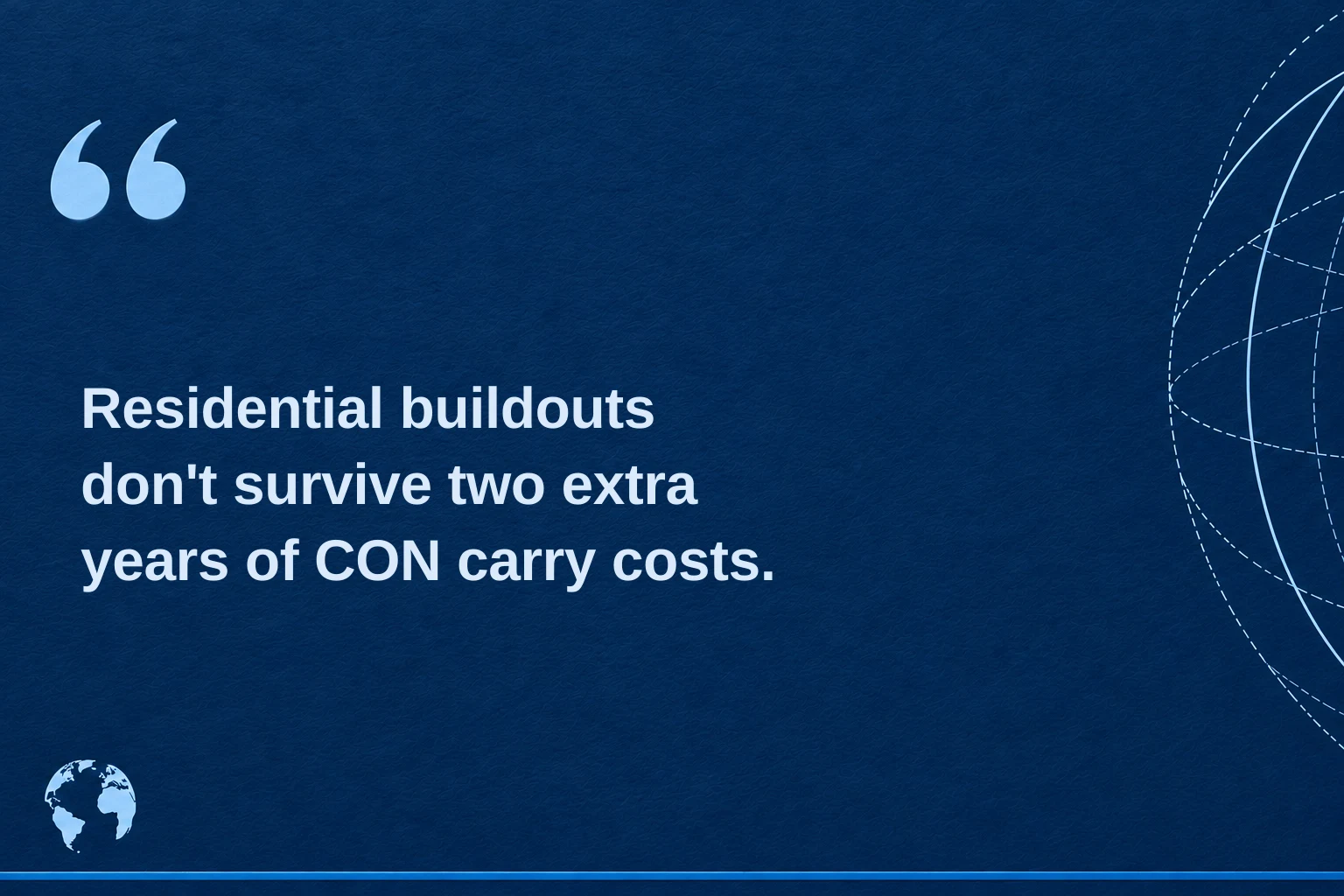
Residential and withdrawal management (including ASAM 4th Edition Level 3.7, Residential Detoxification) are the bed types most likely to trigger CON review, SIU audits, and extended survey windows. In CON states, these can add 12 to 24 months to a project. A 30-bed residential buildout that pencils at roughly $85,000 to $120,000 per bed in hard construction costs before soft costs and working capital does not survive two extra years of carry. In Florida and Texas, which do not apply CON to these beds, the gating item is usually zoning and fire marshal sign-off, not state health planning.
Partial Hospitalization (PHP, ASAM Level 2.5) and Intensive Outpatient are both outpatient levels of care. They almost never trigger CON. They do trigger utilization management scrutiny from commercial payers, especially on length of stay and step-down documentation. If you are opening PHP or IOP in Arizona, Colorado, or North Carolina, your real risk is payer readiness and medical necessity documentation, not state licensure.
Opioid Treatment Programs are their own category. DEA registration, SAMHSA OTP certification, and state opioid authority approval stack on top of state licensure. Tennessee and North Carolina both have state-level needs assessments that function like a soft CON for OTPs. Plan for it.
One more unglamorous point. The 2024 N-SUMHSS found that 72.0% of SU treatment facilities nationally offered medication for opioid use disorder. If your model does not include MOUD, you are increasingly outside the standard of care that commercial payers, Joint Commission surveyors, and CARF reviewers expect to see. 42 CFR Part 2 confidentiality requirements also apply the moment you add MOUD or any federally-assisted SUD program. Factor the policy build into your timeline.
Frequently asked questions
Which states don’t require a Certificate of Need for behavioral health or substance use facilities?
As of the most recent NCSL update, 15 states operate no CON program at all: Arizona, California, Colorado, Idaho, Kansas, Minnesota, New Hampshire, New Mexico, North Dakota, Pennsylvania, South Dakota, Texas, Utah, Wisconsin, and Wyoming. Separately, Florida and Tennessee have active CON programs that specifically exempt most behavioral health projects. Always confirm against the current state statute for your exact bed type.
How long does behavioral health licensure typically take in Florida vs. Texas vs. Arizona?
Florida DCF SUD licensure under 65D-30 typically runs four to eight months from a clean application to a probationary license, assuming the facility passes its initial inspection. Texas HHSC chemical dependency licensure generally runs six to nine months. Arizona ADHS behavioral health licensure under A.A.C. Title 9 Chapter 10 is often the fastest of the three (four to seven months) because ADHS has a well-documented survey process. None of these include the AHCA, OIG, or Medicaid enrollment timelines that run in parallel, which can add another three to six months before you bill a dime.
Which states have the strongest commercial payer mix for residential SUD treatment?
Florida, Texas, Arizona, and Tennessee have historically supported the strongest commercial residential books, driven by out-of-state admissions and employer-sponsored plans. That picture is shifting. In-network commercial residential per diems that sat at $1,100 to $1,400 in 2019 are now commonly authorized in the $750 to $1,050 range in those same markets, and commercial length-of-stay authorizations have tightened across the board since 2022. Mental Health Parity and Addiction Equity Act (MHPAEA) enforcement actions have not meaningfully fixed the problem at the operator level. Build a mixed commercial and Medicaid pro forma or build a cash model; a pure commercial residential bet is riskier in 2026 than it was in 2018.
What role do 1115 SUD waivers play in choosing a state to open a facility?
An approved Section 1115 SUD demonstration lets a state draw Medicaid federal match for residential SUD treatment in facilities with more than 16 beds (the IMD exclusion workaround). If your model relies on Medicaid residential, you almost have to open in a state with an active 1115 SUD demonstration. Arizona, Colorado, North Carolina, and Tennessee all have relevant demonstrations in place; verify the current approval and any pending amendments on the Medicaid.gov 1115 waiver tracker before you sign a lease.
Which states are oversaturated for residential treatment and better suited for PHP/IOP or OTP expansion?
South Florida, metro Phoenix, Nashville, and parts of Colorado’s Front Range are saturated for residential SUD. KFF’s 2024 facility counts show Florida at 178 residential SUD facilities and Arizona at 123, which in practice means referrals are fought over and commercial rates are compressed. In those same markets, PHP, IOP, and OTP still have real entry room, particularly when paired with telehealth and MOUD. The answer is almost never “don’t open in Florida.” It is “don’t open the fifth 20-bed residential in Delray.”
References
- National Conference of State Legislatures, Certificate of Need State Laws
- Cicero Institute, Ranking Certificate of Need Laws in All 50 States (2024)
- SAMHSA, 2024 N-SUMHSS Companion Infographic Report
- SAMHSA, National Substance Use and Mental Health Services Survey 2024 Annual Report
- KFF State Health Facts, Number of Substance Use Treatment Facilities By Type of Care (2024)
- KFF State Health Facts, Opioid Overdose Death Rates (CDC WONDER, 2024)
- CDC NCHS, U.S. Overdose Deaths Decrease Almost 27% in 2024
- Florida Administrative Code, Chapter 65D-30 (SUD Treatment Licensure)