



Table of Contents
Ready to See Results?
From strategy through execution, Atlantic Health Strategies integrates compliance, operations, and growth into durable, measurable results. Let’s put our expertise to work for your organization.
The Short Answer: What Behavioral Health Credentialing Is (and Why It Stalls Revenue)
Behavioral health credentialing typically runs 90 to 150 days for commercial payers and 60 to 180 days for state Medicaid, and the first billable date is not the credentialing approval date. It is the date enrollment (EFT, ERA, PECOS, or the state Medicaid portal) is fully open. If a billing lead confuses the two, clinicians will treat patients for weeks and the practice will collect nothing.
Credentialing is the verification step. Payers confirm a clinician’s licensure, education, training, work history, malpractice coverage, and sanctions status before that clinician can bill as in-network. Most groups route provider data through the CAQH Provider Data Portal (now branded DataSpring). From there, each payer runs primary source verification against state license boards, DEA records where applicable, board certifications, and the HHS-OIG List of Excluded Individuals/Entities (LEIE).
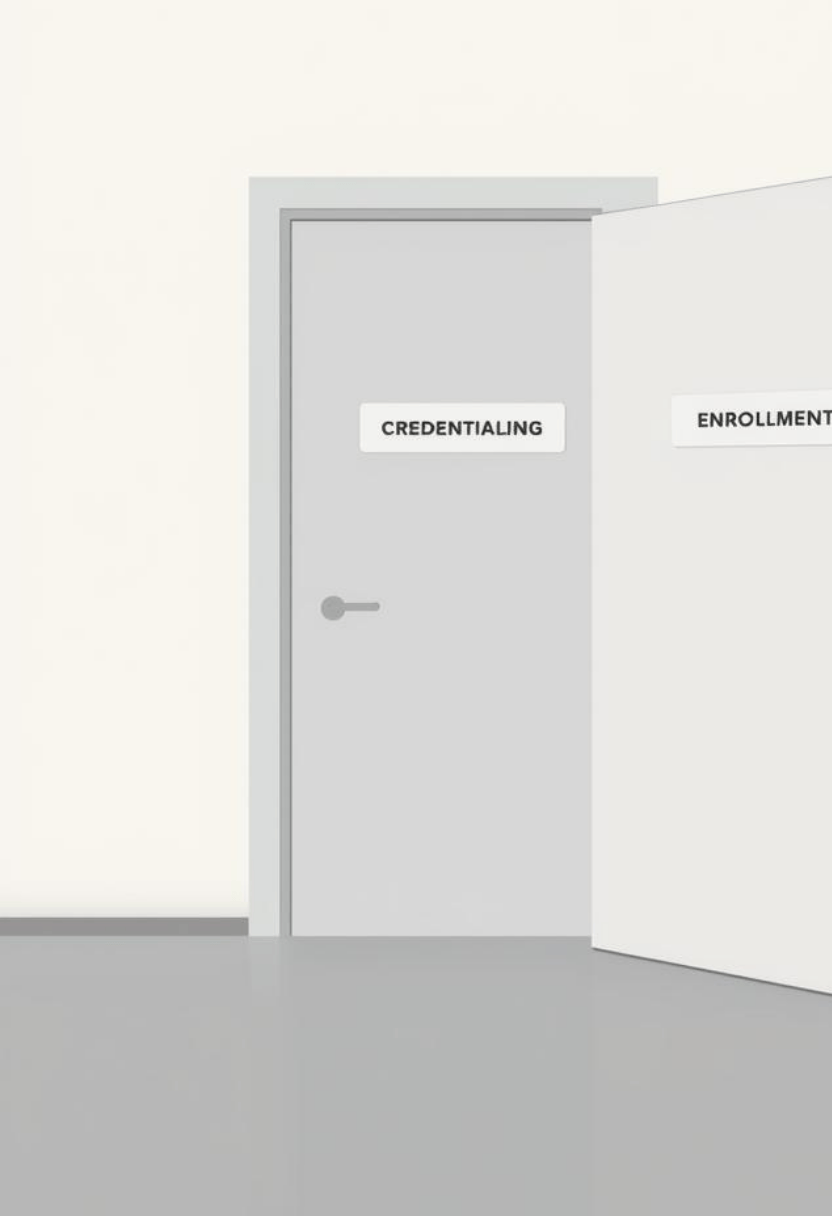
Operators routinely conflate three things that are legally distinct: credentialing, contracting, and enrollment. Credentialing decides whether a clinician is eligible to participate. Contracting sets the rates and the terms. Enrollment (EFT, ERA, PECOS for Medicare, the state portal for Medicaid) opens the payment pathway.
Last quarter my team watched a Texas group practice burn 60 days waiting on a first payment because their billing lead assumed a credentialing approval letter meant enrollment was done. It did not. Delay a single mid-level prescriber for 90 days and the practice loses a full quarter of contribution margin per clinician. Multiply that across a five-clinician onboarding class and the credentialing function stops being administrative. It becomes the revenue gate.
How Long Behavioral Health Credentialing Takes, and Why It Drags

Most commercial payers close clean files in 90 to 150 days. Behavioral health work adds layers: primary source verification, work history and reference checks, background checks, supervision attestations for associate-level clinicians, and payer enrollment. Medicaid is the wildcard, with state timelines running roughly 60 to 180 days depending on the agency’s processing speed, application completeness, and site-visit requirements.
NCQA tightened the rules effective July 1, 2025. As Verifiable’s summary of the change puts it plainly, “the most significant change to NCQA guidelines is the reduction in verification timeframes.” Operationally, the impact on practitioners is severe: the primary source verification window was reduced from 180 days to 120 days for Credentialing Accreditation and to 90 days for Credentialing Certification under the July 2025 NCQA updates. Payers now have less time to clean up a sloppy file before the clock forces a restart. Submit garbage, get pushed to the back of the queue.
NCQA also expanded ongoing monitoring. Organizations must check exclusion lists every month against the OIG LEIE, SAM.gov, the NPDB, and applicable state boards, with documented escalation to a peer-review body when something turns up.
Behavioral health pays a specific tax on manual workflows. According to the 2024 CAQH Index Report, providers and staff spend an average of 24 minutes per prior authorization request using phone, fax, or email, and each manual prior authorization costs approximately $3.41 per transaction. Multiply that across hundreds of authorizations per month at a multi-site platform and the drag on revenue-cycle labor is real. CAQH also flagged a systemic waste number: the 2024 Index identified a $20 billion opportunity to reduce administrative waste, with 70 minutes saved per patient visit when providers use fully automated administrative workflows.
States layer their own complexity on top. CMS designates most behavioral health agencies at the moderate screening level, which triggers unannounced site visits under 42 CFR 455.432. My enrollment playbook for Florida is not my enrollment playbook for Pennsylvania. Under 42 CFR 455.450, high-risk designation reaches any person with 5 percent or greater direct or indirect ownership in the provider, which lengthens timelines by weeks once fingerprint-based background checks are added.
Insurance Contracting: Where New Behavioral Health Practices Lose the Margin
Contracting starts where credentialing ends, and it deserves more attention than most founders give it. Founders accept default rates to get on a panel quickly, then spend the next three years trying to renegotiate from a position of weakness. Once a fee schedule is signed, negotiating power is gone until the contract anniversary, and sometimes longer.
The behavioral-health-specific traps live in the contract language. Read the incident-to billing rules, group billing versus individual billing structures, telehealth coverage and originating-site language, supervisory billing for associate-level clinicians, and how the payer treats ASAM Criteria, 4th Edition levels of care. A contract that does not explicitly authorize Level 2.5 partial hospitalization (an outpatient level of care) or Level 3.7 residential withdrawal management will generate denials that a billing team cannot fix after the fact.
Parity adds another dimension. Under the Mental Health Parity and Addiction Equity Act (MHPAEA), payers cannot apply more restrictive utilization management, prior authorization, or network admission criteria to behavioral health than to medical-surgical benefits. My contracting team has invoked that statute in Texas and Florida payer negotiations when a plan tried to attach concurrent-review requirements that would not survive a parity audit. Ground your contracting attorney in the statute before they sit down to negotiate rates.
The Delay Drivers Nobody Wants to Own
Payers get blamed for everything. The truth is messier. The most common breakdowns my team sees in mock file reviews are internal: expired CAQH attestations (which must be re-attested every 120 days), unsigned malpractice declarations, work history gaps the provider “forgot,” NPI taxonomy codes that do not match the licensure on file, and supervision attestations missing for associate clinicians.
Exclusion screening is the silent killer. OIG directs providers to check the LEIE on a monthly basis, and in connection with any new enrollments, so that state Medicaid programs do not enroll or continue the enrollment of any individual or entity excluded from participation in all Federal health care programs. Because the LEIE is refreshed monthly, monthly screening is the cadence compliance professionals follow.
The arithmetic is brutal. OIG can impose civil monetary penalties for employing or contracting with an excluded individual, and each item or service furnished by that person is a separate violation. Enforcement is real and documented. After it self-disclosed conduct to OIG, Lee Health System, Inc., Fort Myers, Florida, agreed to pay $18,848,530.40 for allegedly violating the Civil Monetary Penalties Law. OIG alleged, in part, that Lee Health employed individuals it knew or should have known were excluded from participation in Federal health care programs. Missed hires, eight figures out the door.
Texas operators get an extra layer. HHS-OIG and the Texas HHSC-OIG maintain separate lists of excluded individuals and entities, and providers must check both while employing or contracting with any individual or entity, then keep the documentation. If an HR file does not show a date-stamped screening for every hire, every month, the operator does not have a defense.
The other internal failure is treating recredentialing as a one-time event. NCQA requires providers to be recredentialed every 36 months from the last approval date, on a fixed documented cycle, with monthly checks of OIG, SAM.gov, the NPDB, and state licenses. Miss the window and clinicians can be silently terminated from a network. The billing team finds out when claims start denying 60 to 90 days later.
Selecting a Credentialing Partner That Scales With Your Platform
A single solo therapist getting credentialed is a checklist. A 40-clinician multi-site behavioral health platform with Medicare, three state Medicaid programs, six commercial payers, and a private equity sponsor watching the EBITDA is a system. Most firms cannot tell the difference.
What I screen a credentialing partner on:
- Do they centralize provider data architecture in one source of truth?
- Do they track effective dates and recredentialing deadlines proactively, not when the payer sends a notice?
- Do they run monthly LEIE and SAM.gov screenings with date-stamped evidence?
- Do they integrate contracting with credentialing so a clinician’s first claim is not the moment the practice discovers a fee-schedule problem?
- Can they actually pick up the phone to a payer credentialing department in Texas, Florida, or Pennsylvania?
The tailwind for getting this right is real. According to the 2024 CAQH Index Report, each manual prior authorization costs approximately $3.41 per transaction, but automation drops that cost to $0.05 per transaction, a savings of more than 98 percent per transaction when scaled across hundreds of thousands of transactions per year. Operators who build credentialing as infrastructure capture that margin. Operators who do not, write it back to the payers in the form of denied claims and stalled go-lives.
Frequently asked questions
How long does behavioral health credentialing take from submission to first billable date?
Commercial payers typically close clean files in 90 to 150 days. State Medicaid runs 60 to 180 days depending on the agency. Under the July 1, 2025 NCQA update, the primary source verification window is 120 days for Credentialing Accreditation and 90 days for Credentialing Certification. Plan another roughly 30 days after credentialing approval for enrollment setup (EFT, ERA, PECOS or the state Medicaid portal) before the first claim actually pays.
What is the difference between credentialing, contracting, and provider enrollment?
Credentialing verifies the clinician is qualified to participate (license, education, work history, sanctions, malpractice). Contracting sets the legal and economic terms (fee schedule, covered services, telehealth rules, parity provisions under MHPAEA). Enrollment opens the payment pathway after credentialing approval, including PECOS for Medicare, the state portal for Medicaid, and EFT and ERA setup with each commercial payer. A practice can be credentialed and contracted and still not get paid because enrollment is incomplete.
How often must we screen employees and contractors against exclusion lists?
At least monthly, against the HHS-OIG LEIE, SAM.gov, and every applicable state Medicaid exclusion list. OIG guidance directs providers to check the LEIE on a monthly basis so state Medicaid programs do not enroll or continue enrollment of any excluded individual or entity. The Lee Health System settlement in Fort Myers, Florida ($18,848,530.40 tied in part to employing individuals the organization knew or should have known were excluded) is the cautionary tale operators should keep in front of the compliance committee.
When does recredentialing happen and what breaks if we miss it?
NCQA requires recredentialing every 36 months from the last approval date, on a fixed documented cycle, with the process initiated 90 to 120 days before the anniversary. Miss the window and payers can silently terminate the clinician from the network, at which point claims start denying 60 to 90 days later and the revenue-cycle team discovers the gap on a lagging report.
References
- HHS-OIG Exclusions Program and LEIE (monthly-check guidance)
- HHS-OIG Enforcement Action: Lee Health System $18.8M CMP Settlement
- eCFR: 42 CFR 455.432 – Site Visits (Medicaid Provider Screening)
- 42 CFR 455.450 – Screening Levels for Medicaid Providers
- NCQA Credentialing Standards: 2025 Updates Summary
- Verifiable: Get Ahead of the 2025 Changes to NCQA Credentialing Guidelines
- CAQH: 2024 Index Reveals $20B Savings Opportunity
- HealthEdge Analysis of 2024 CAQH Index: Prior Authorization Cost per Transaction
- Texas HHS: HHS-OIG and HHSC-OIG Separate LEIE Requirements